

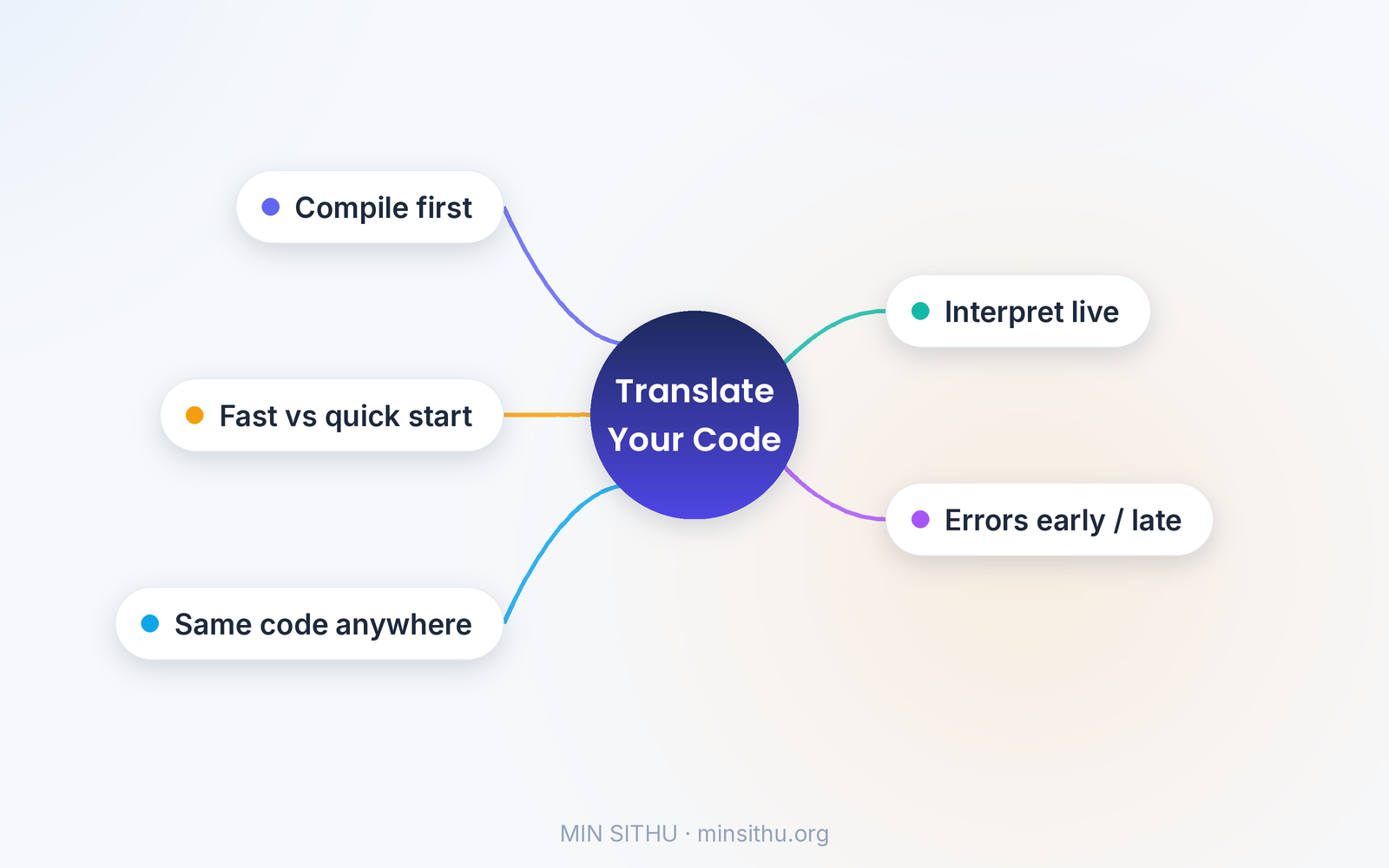
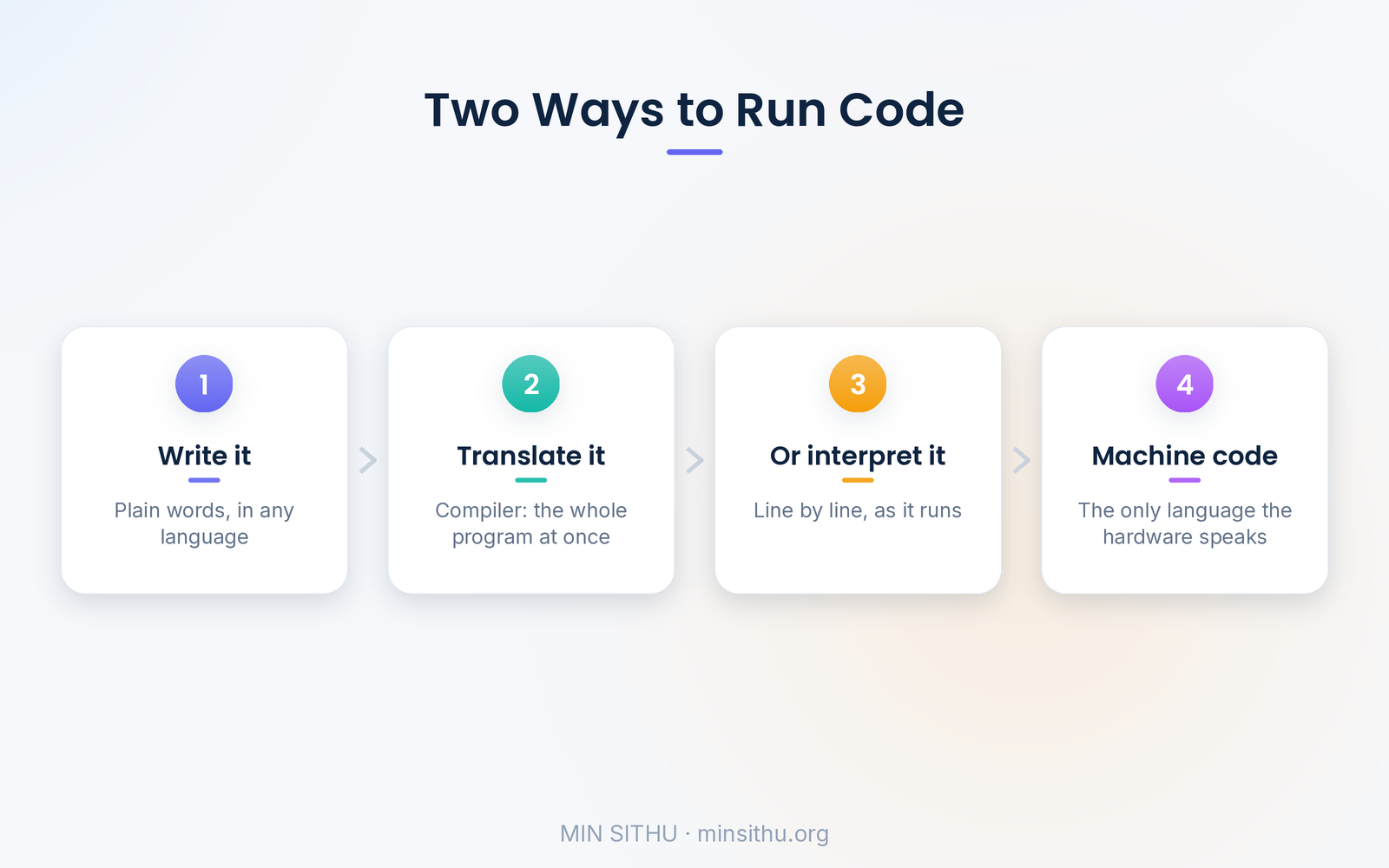
To put it simply, your computer does not understand Python, JavaScript, or any language you write. It only understands machine code — long strings of zeros and ones that tell the hardware exactly what to do. Something has to translate your readable code into that machine code, and that something is either a compiler or an interpreter. They both do the same job, but they do it at very different moments, and that timing changes everything about how your program behaves.
The common mistake is thinking the computer reads your code directly. It never does. When you write print("hello") and run it, a whole translation step happens in between, and which kind of translator you have decides whether your program runs fast or slow, whether you find your mistakes early or late, and whether you can run the same code on another machine at all.
Think of it like a book. A compiler is a translator who reads the whole book, translates every page, and hands you a finished copy in the new language. An interpreter is a translator who sits next to you and translates out loud, line by line, as you read. The first one takes longer up front but the reading is smooth after that. The second one starts instantly, but you have to wait for every single line.
The compiler translates everything first
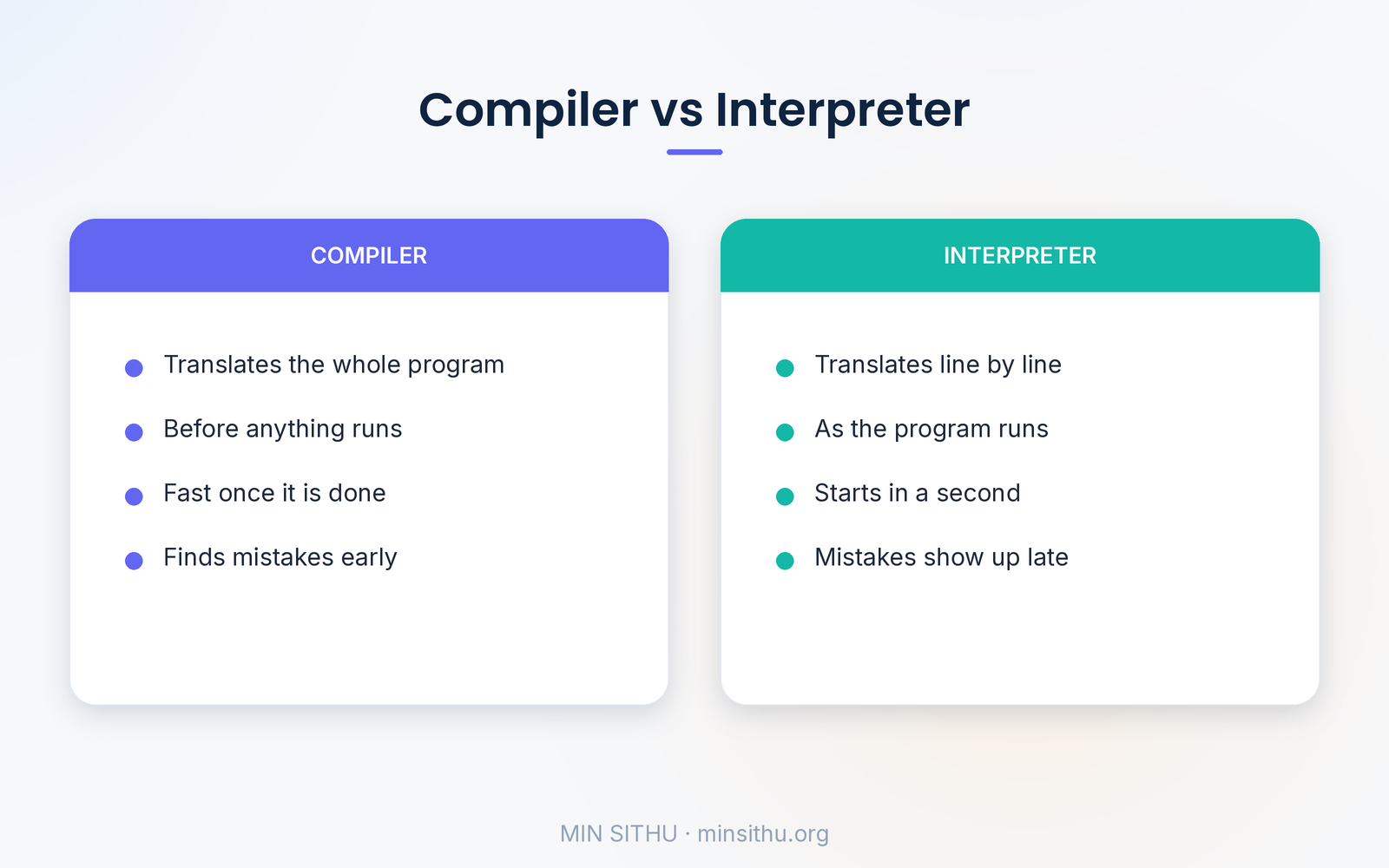
A compiler reads your entire program before anything runs. It goes through the whole file, checks it for mistakes, and turns it into a separate program in machine code — an executable file you can run again and again. C, C++, Rust, and Go work this way.
That upfront work buys you two things. First, speed: once the translation is done, the computer runs the finished machine code directly, with no translator in the way. That is why compiled languages are usually the choice for games, operating systems, and anything where every millisecond matters. Second, early error checking: if you made a typo on line 200, the compiler finds it before the program ever starts. You cannot run a program that does not compile, which is annoying in the moment and wonderful in the long run.
The price is waiting. Every time you change one line, you have to translate the whole program again before you can test it. And the finished program only runs on the machine it was built for — a program compiled for Windows does not run on a Mac, because the machine code is different.
The interpreter translates as it goes
An interpreter does not produce a separate translated file. It reads your code one line at a time and runs each line immediately. Python, JavaScript, and Ruby work this way.
The short version: an interpreter is like a live translator at a meeting — fast to start, slower line by line, and it only discovers a mistake when it reaches it.
That gives you a completely different way of working. You can change one line and run the program again in a second, which makes experimenting easy. You can type a line of code, see what it does, and fix it straight away. That is a big reason Python is so popular for learning and for quick scripts — the gap between writing code and seeing it run is almost nothing.
The trade-off is speed. The translator is working while the program runs, so every line costs a little extra time. And mistakes hide until the interpreter reaches them. Your program can run happily for ten minutes, then crash on a typo in a line it only reaches at the end.
Here is the smallest version of the idea, in code. This is the same little program in both worlds:
# Python (interpreted) — run it straight away
total = 0
for number in [3, 7, 2]:
    total = total + number
print(total)
In Python you save the file and run it, and the interpreter reads each line and does it. In C, the same idea looks like this, and you have to compile it first:
// C (compiled) — translate first, then run
#include <stdio.h>
int main() {
    int total = 0;
    int numbers[] = {3, 7, 2};
    for (int i = 0; i < 3; i++) total += numbers[i];
    printf("%d\n", total);
    return 0;
}
The C version needs a compiler step — gcc program.c -o program — before you get anything you can run. The Python version just runs. Both end up doing the same addition, and the C version will do it faster, but the Python version got there with less waiting around.
The middle ground most languages actually live in
Real life is messier than two neat boxes, and that is worth knowing. Java compiles your code, but not into machine code — into an in-between language called bytecode, which a virtual machine then interprets or translates on the fly. JavaScript engines in your browser do something similar: they start by interpreting, then quietly compile the hot parts of your code while it runs, a trick called just-in-time compilation. Python does it too: it compiles your code into bytecode first, then interprets that.
So the honest answer is that most modern languages are a mix. They borrow a little from both sides — compile what they can ahead of time, interpret the rest on the fly — because each approach covers the other's weakness.
Which one should you pick?
Put side by side, the difference is easy to see:
| Compiler | Interpreter | |
|---|---|---|
| When it translates | Before the program runs | While the program runs |
| What you get | A separate runnable file | Nothing — it runs the source directly |
| Speed | Fast, once compiled | Slower, line by line |
| Finding mistakes | Before anything runs | Only when the bad line is reached |
| Running elsewhere | Needs a rebuild per machine | Same code runs anywhere the interpreter exists |
| Best for | Games, systems, performance | Learning, scripts, quick experiments |
The verdict is simple: if you are learning or building something quickly, an interpreter lets you move fast and see results immediately. If you are building something that has to run fast and run for a long time, a compiler pays for its upfront cost many times over.
The deeper point is that neither side is "better" in general — they are two answers to the same question, which is when to pay for translation. Pay early and you get speed and safety. Pay as you go and you get flexibility and a short feedback loop. Every language you will ever learn sits somewhere on that scale, and once you know where it sits, a lot of its behaviour starts to make sense.
Takeaways:
- Your computer only runs machine code — a compiler or an interpreter does the translating
- A compiler translates the whole program first, into a file you can run again and again
- An interpreter translates line by line as the program runs, so you start instantly but run slower
- Compiled code finds mistakes before running; interpreted code finds them when it reaches them
- Most modern languages mix both — Java compiles to bytecode, browsers compile JavaScript just in time
- Pick by the job: speed and safety favour compiling, quick experiments favour interpreting
References and further reading
- Compiler — Wikipedia
- Interpreter (computing) — Wikipedia
- Just-in-time compilation — Wikipedia
- Python documentation — the Python tutorial
— Min SiThu Software Engineer & Tech Content Creator https://minsithu.org
About the author
- Nubbad Developer. | Now I accidentally create problems.
Comments
Join the discussionNo comments yet. Be the first to comment.